Prostate diseases
Adenoma and chronic prostatitis, as a rule, develop against the background of prolonged stagnant phenomena in the prostate gland, after suffering from gonorrhea. The infection is introduced with prostatitis and the adenoma gland enlarges with symptoms of difficulty urinating. In both cases, the sexual function weakens. We consider hirudotherapy to be a very effective technique in the complex treatment of these diseases. By eliminating blood stasis, it affects the very basis of the disease.
Treatment of prostatitis, adenoma
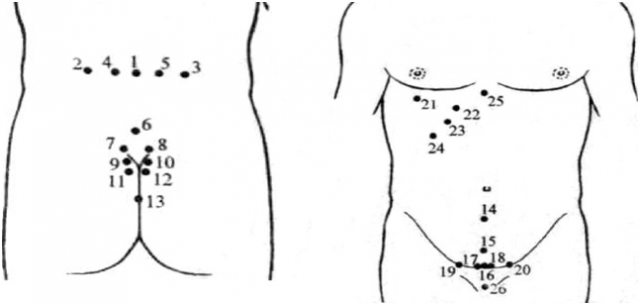
Leech attachment zones.
- Pubic region — points along the midline directly at the base of the penis and above the pubic bone (16, 26), points 17 and 18 - 1.5 centimeters outward from point 16.
- Lower abdominal zone: along the midline, point 15 four fingers above point 16 and point 14 three fingers below the navel; points 19 and 20 in the groin areas.
- Sacral zone — the top of the coccyx (point 13), the projection area of the sacrum (points 6, 7, 8, 9, 10, 11, 12).
- Lumbar zone — point 1 along the midline at the level of the 2nd and 3rd lumbar vertebrae, two and four fingers outward from it on either side (points 4 and 5, 2 and 3, respectively).
- The liver zone is the area in the projection of the liver and right hypochondrium (points 21, 22, 23, 24), point 25 at the top of the xiphoid process.
Features of the procedures.
The procedures are carried out with an emphasis on the points of zones 1, 2 and 3. Zones 4 and 5 are used no more than once per course of treatment and, as a rule, at the end of it. Local points are of primary importance. Treatment should be carried out under the supervision of a urologist.
Number of leeches: 3-5 leeches per procedure.
Number and frequency of sessions: procedures are carried out every other day. The course of treatment is 12 procedures. As a rule, 3-4 repeated courses of treatment are required, although the first one already gives a visible improvement in the patient’s well-being.
-
Also read
- Varicose veins
- Peptic ulcer of the stomach and duodenum
- Acute and chronic hemorrhoids, anal fissures
- Acute mastitis, lactostasis
- Acute and chronic thrombophlebitis
- Hirudotherapy for allergies
- Hirudotherapy for bronchial asthma
- Hirudotherapy for bronchitis
- Hirudotherapy for hypertension
- Hirudotherapy for heart failure
- Hirudotherapy for cardialgia
- Hirudotherapy for chronic constipation
- Hirudotherapy for hepatitis and liver cirrhosis
- Hirudotherapy for chronic pancreatitis
- Benign tumors of the uterus and appendages
- Inflammatory diseases of the skin and subcutaneous tissue abscesses
- Ear disease
- Kidney diseases
- Uterine bleeding
- Bone fractures and chronic osteomyelitis
- Radiculitis
- Treatment of ENT diseases with medical leeches
- Adhesion process
- Bruises, contusions, consequences of injuries
- Painful menstruation
- Chronic non-healing ulcers
- Chronic inflammatory diseases of the uterus and appendages