Hirudotherapy for hypertension
The main symptom of the disease is high blood pressure. Dysregulation of blood pressure can occur as a result of neuropsychiatric overstrain, hemodynamic disorders, kidney disease, or hormonal imbalance. Often the causes of the disease are of a mixed nature. Much of the success of treatment is determined by a correct understanding of the mechanisms of the disease.
In addition to the treatment of hypertension, hirudotherapy is particularly effective in hypertensive crisis (sudden rises in blood pressure), which is very dangerous and causes strokes (hemorrhages in the brain). In all cases of pre-stroke state (signs of cerebral circulatory disorders) in patients with hypertension, hirudotherapy is extremely necessary.
Treatment of hypertension.
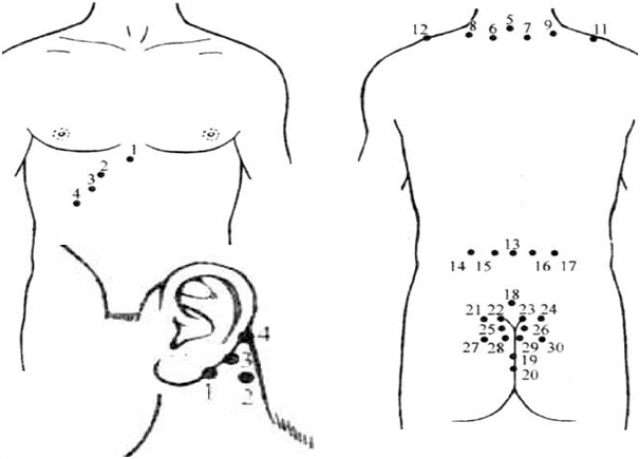
Leech application zones.
- The parotid zone - behind the auricle and on the mastoid process (points 1, 2, 3, 4 - see the head drawing).
- The sacrum zone: the area of the sacro-coccygeal joint, the end of the coccyx (points 19, 20), the projection area of the sacrum (points 21, 22, 23, 24, 25, 26, 27, 28, 29, 30).
- Below the 7th cervical vertebra along the midline and two points 2-4 centimeters to the right and left of the midline (points 5, 6, 7).
- The zone in the middle part above the right and left shoulders (points 8, 9, 11, 12). The lumbar zone - point 13 at the level of the 2nd and 3rd thoracic vertebrae along the midline, two and four transverse fingers outside of it on both sides (points 14, 15, 16, 17).
- The liver zone - the projection area of the liver and the right hypochondrium (points 1, 2, 3, 4).
Features of the procedures.
The treatment of hypertension with leeches is a kind of art. The selection and combination of points, the duration and intensity of the course are determined by the nature and causes of the disease. It is not always possible to achieve a positive effect, but it is usually possible to at least alleviate the patient’s condition, relieve headaches and improve cerebral circulation. Zones 3 and 4 are used in combination with the points of zone 2. They are used in the presence of pronounced vegetative reactions (dizziness, feeling of heat, sweating), with increased emotional excitability. It should be emphasized that zone 2 is the main one in the treatment of hypertension. In case of renal genesis, it is necessary to include zone 5 in the course of treatment with an emphasis on the more affected kidney.
Particular attention should be paid to the problem of treating a hypertensive crisis. A great deal of practical experience in the successful use of leeches in crisis states, when hospital therapy gives an insignificant or short-term result, allows us to confidently speak of the expediency of not so much local (on the area of the mastoid processes) as reflex and distracting effects. That why, we recommend putting leeches on the points of the coccyx and sacrum (zone 2), then on the points of the liver zone 6, and only then on the points of the parotid region of zone 1. Moreover, in some cases (depending on the crisis state), the local application of leeches can lead to the development of a paradoxical reaction, accompanied by an increase, rather than a decrease, in venous plethora.
Number of leeches: in a hypertensive crisis, up to 4 leeches are used in the first procedures. After the pressure decreases, the number of leeches is reduced.
Number and frequency of sessions: procedures in the acute case should be carried out daily. When the crisis is over, the procedures are carried out 1-2 times a week. The course of treatment is 7-9 procedures.
Combination with other methods of naturopathy: hirudotherapy should be carried out against the background of a normal diet, rational relaxation therapy, and phytotherapy. Therapeutic fasting is possible.
-
Also read
- Varicose veins
- Peptic ulcer of the stomach and duodenum
- Acute and chronic hemorrhoids, anal fissures
- Acute mastitis, lactostasis
- Acute and chronic thrombophlebitis
- Hirudotherapy for allergies
- Hirudotherapy for bronchial asthma
- Hirudotherapy for bronchitis
- Hirudotherapy for heart failure
- Hirudotherapy for cardialgia
- Hirudotherapy for chronic constipation
- Hirudotherapy for hepatitis and liver cirrhosis
- Hirudotherapy for chronic pancreatitis
- Benign tumors of the uterus and appendages
- Inflammatory diseases of the skin and subcutaneous tissue abscesses
- Ear disease
- Kidney diseases
- Uterine bleeding
- Bone fractures and chronic osteomyelitis
- Radiculitis
- Prostate diseases
- Treatment of ENT diseases with medical leeches
- Adhesion process
- Bruises, contusions, consequences of injuries
- Painful menstruation
- Chronic non-healing ulcers
- Chronic inflammatory diseases of the uterus and appendages