Hirudotherapy for bronchitis
Acute and chronic bronchitis is an inflammatory process in the bronchi associated with the action of various factors on the body (infectious, chemical, physical). It is often a manifestation of an allergic reaction of the body to external factors. Given the weakening of the immune system in the population and the inadequacy of the classical approach to treatment, acute bronchitis often becomes chronic (especially in the elderly). The main symptom is a cough that worsens in cold and damp weather. The nature and amount of sputum may vary. In protracted acute bronchitis, as well as in cases of chronic bronchitis with a large amount of viscous sputum and the presence of congestion in the lungs, the use of hirudotherapy is very effective. In other forms of the disease, hirudotherapy is used as an auxiliary method of treatment to stimulate immune processes, improve metabolism and reduce venous plethora.
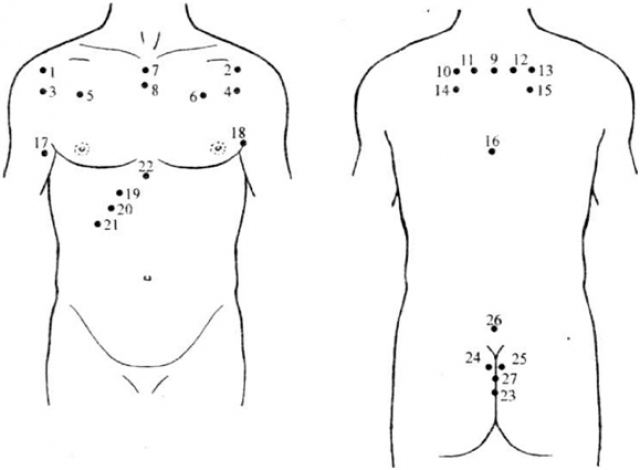
Leech application zones.
- Lung zone - points at the level of the I and II intercostal spaces along the deltoid-thoracic sulcus (points 1, 2, 3, 4). A point in the II intercostal space along the midclavicular line (5, 6), two points from the sternum zone (7, 8).
- Splenic points 17 and 18, located symmetrically on the right and left lateral surfaces of the body along the axillary line four transverse fingers below the top of the axillary fossa.
- Interscapular zone - point 9 at the level of the 3rd and 4th thoracic vertebrae along the midline and two and four transverse fingers outward from it (points 10, 11, 12, 13), points 14 and 15, located 2-3 centimeters below points 12 and 13, respectively, point 16 along the midline at the level of the lower angle of the scapulae.
- Sacral zone - points in the area of the end of the coccyx (23, 27), in the projection area of the sacrum (24, 25, 26).
- Liver zone - points in the right hypochondrium (19, 20, 21) and point 22 at the top of the xiphoid process.
Peculiarities of the procedures.
Procedures are performed sequentially in zones 1, 2, and 3. The points of the interscapular zone are of particular importance. Leeches are applied with maximum exposure (until they fall out themselves). Points 3, 4 and 11, 12 should, as a rule, be taken in pairs, the others - on the side of the predominant localization of the pathological process. Zones 4 and 5 should be included in the course of treatment in the presence of pronounced congestion in the lungs. They can also be used for pulmonary edema.
Number of leeches: in the first procedures, 2-3 leeches per procedure, gradually increasing their number to 5-7 per session.
Number and frequency of sessions: 3-4 procedures are performed every other day, then 2 times a week. The course of treatment is 7-8 procedures.
Combination with other methods of naturopathy: hirudotherapy is an auxiliary method. An excellent result is given by its combination with hot chest wraps, breathing exercises and phytotherapy. Massage and phyto-inhalations are also recommended.
-
Also read
- Varicose veins
- Peptic ulcer of the stomach and duodenum
- Acute and chronic hemorrhoids, anal fissures
- Acute mastitis, lactostasis
- Acute and chronic thrombophlebitis
- Hirudotherapy for allergies
- Hirudotherapy for bronchial asthma
- Hirudotherapy for hypertension
- Hirudotherapy for heart failure
- Hirudotherapy for cardialgia
- Hirudotherapy for chronic constipation
- Hirudotherapy for hepatitis and liver cirrhosis
- Hirudotherapy for chronic pancreatitis
- Benign tumors of the uterus and appendages
- Inflammatory diseases of the skin and subcutaneous tissue abscesses
- Ear disease
- Kidney diseases
- Uterine bleeding
- Bone fractures and chronic osteomyelitis
- Radiculitis
- Prostate diseases
- Treatment of ENT diseases with medical leeches
- Adhesion process
- Bruises, contusions, consequences of injuries
- Painful menstruation
- Chronic non-healing ulcers
- Chronic inflammatory diseases of the uterus and appendages