Hirudotherapy for bronchial asthma
Bronchial asthma is an allergic condition of the body that manifests itself at the level of the bronchi. The disease is accompanied by attacks of suffocation caused by bronchospasm, excessive secretion and swelling of their mucous membrane. It can occur against the background of signs of venous plethora mainly of the chest organs, abdominal cavity (intestines, liver, stomach), and pelvic organs (uterus and appendages in women, prostate gland in men). All this is extremely important to consider for the correct choice of treatment tactics.
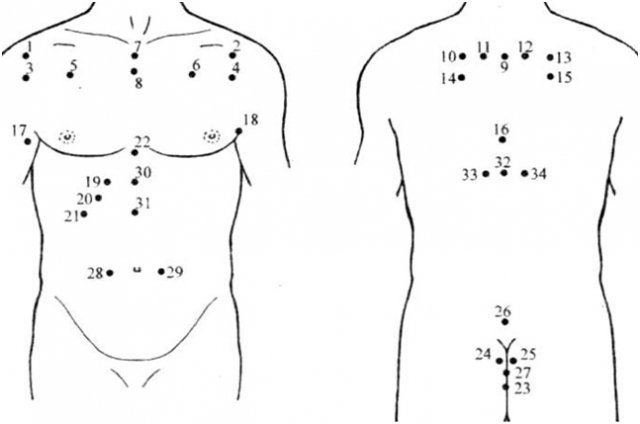
Leech application zones.
- Lung zone - points at the level of the I and II thoracic sulcus (points 1, 2, 3, 4). Symmetrical points 5 and 6 in the II intercostal space along the mid-clavicular lines, two points 7 and 8 from the sternum zone.
- Splenic points 17 and 18, located symmetrically on the right and left lateral surfaces of the body along the axillary line four transverse fingers below the apex of the axillary fossa.
- Interscapular zone - a point at the level of the 3rd, 4th thoracic vertebrae of the midline and two and four transverse fingers outward (points 10, 11, 12, 13), points 14 and 15, located 2-3 centimeters below points 12 and 13, respectively, point 16 along the midline at the level of the lower corner of the scapulae.
- Sacral zone - points in the area of the end of the coccyx (23, 27), in the projection area of the sacrum (24, 25, 26).
- Liver zone - the area in the projection of the liver and the right hypochondrium (points 19, 20, 21) and point 22 at the top of the xiphoid process.
- Anterior-abdominal zone - symmetrical points 28 and 29 at the level of the navel two transverse fingers outward and points 30, 31 in the meso-gastric region along the midline (as a rule, with pathology they are slightly painful).
- Interscapular zone - point 32 along the midline at the level of the 9th, 10th thoracic vertebrae and two transverse fingers outward from it (points 33, 34).
Peculiarities of the procedures.
The creation of an effective scheme for the treatment of patients with bronchial asthma with leeches largely depends on the correctness of the assessment of the mechanisms of the disease. This is a kind of art. In the general case, in addition to including zones 1, 2, 3 in the course, we recommend focusing on the presence of signs of venous plethora. If they appear mainly on the organs of the chest - the emphasis is on zones 1, 2, 3, 5, the abdominal cavity - add zones 5, 6 and 7, in the pelvic area - zone 4 with an increase in the number of points used.
Number of leeches: as a rule, you should not rush to increase the number of leeches per procedure. We use from 2, rarely 6-8, as a rule, 3-4, leeches per procedure. The number of animals largely depends on the patient’s condition and the duration of the general course.
Number and frequency of sessions: at the beginning of the first course of treatment, as a rule, 4 procedures are carried out 2 times a week, then once a week up to 7-8 procedures per course of treatment. The courses are repeated with an interval of 2-4 weeks. A total of 3 courses of treatment.
Combination with other methods of naturopathy: hirudotherapy is a very effective method in the treatment of bronchial asthma, especially in the presence of signs of venous plethora. However, it must be combined with hot chest wraps, breathing exercises, restoration of the principles of natural nutrition, procedures for cleansing the body, and phytotherapy. Therapeutic fasting gives a good effect (do not carry out simultaneously with hirudotherapy).
-
Also read
- Varicose veins
- Peptic ulcer of the stomach and duodenum
- Acute and chronic hemorrhoids, anal fissures
- Acute mastitis, lactostasis
- Acute and chronic thrombophlebitis
- Hirudotherapy for allergies
- Hirudotherapy for bronchitis
- Hirudotherapy for hypertension
- Hirudotherapy for heart failure
- Hirudotherapy for cardialgia
- Hirudotherapy for chronic constipation
- Hirudotherapy for hepatitis and liver cirrhosis
- Hirudotherapy for chronic pancreatitis
- Benign tumors of the uterus and appendages
- Inflammatory diseases of the skin and subcutaneous tissue abscesses
- Ear disease
- Kidney diseases
- Uterine bleeding
- Bone fractures and chronic osteomyelitis
- Radiculitis
- Prostate diseases
- Treatment of ENT diseases with medical leeches
- Adhesion process
- Bruises, contusions, consequences of injuries
- Painful menstruation
- Chronic non-healing ulcers
- Chronic inflammatory diseases of the uterus and appendages